

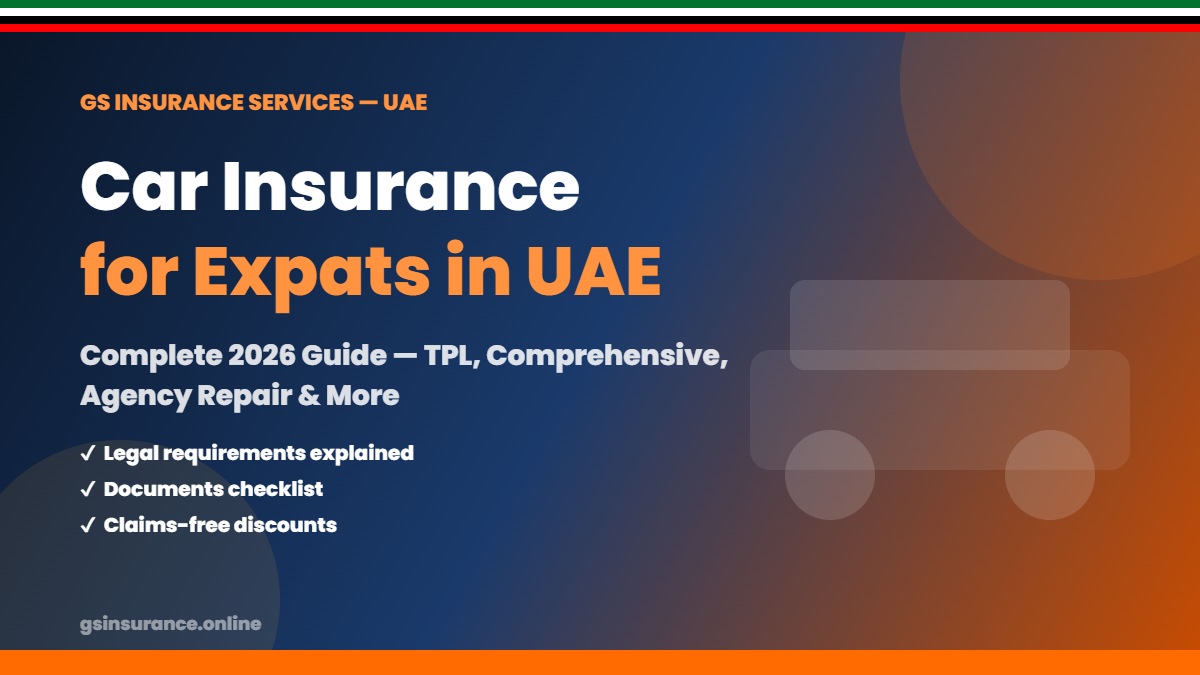
If you have recently moved to the UAE or are planning to drive here, car insurance for expats in UAE is not optional — it is a legal requirement for every vehicle on the road, regardless of your nationality or visa status. The good news is that the rules are the same for everyone. The Central Bank of UAE (CBUAE) sets a fixed tariff that applies to all drivers equally, so as an expat you have exactly the same rights and protections as a UAE national.
Car Insurance for Expats in UAE: The Legal Requirement
Every vehicle registered in the UAE must carry at least third party liability (TPL) insurance before it can be registered or have its registration (mulkiya) renewed. This applies to all residents — expats and UAE nationals alike. Driving without valid insurance is a traffic offence that results in fines, vehicle impoundment, and rejection at the registration counter.
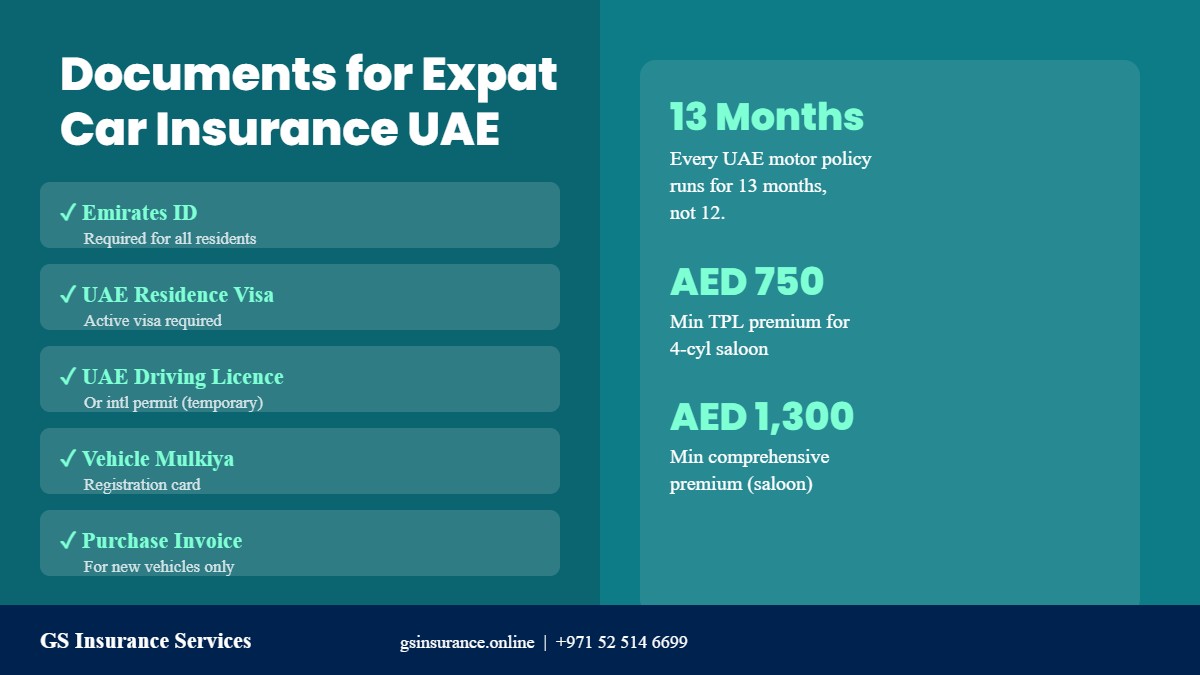
For expats, the process is straightforward: once you have your UAE residence visa and Emirates ID, you can insure your vehicle immediately. The insurance runs for 13 months — not 12 — as specified in the CBUAE tariff. This extra month is built into every UAE motor policy regardless of the insurer.
Documents You Need as an Expat
To buy car insurance for expats in UAE, you will need: your Emirates ID, your UAE residence visa, your UAE driving licence, and your vehicle registration card (mulkiya). If you are buying insurance for a new vehicle before your first registration, you will need the purchase invoice or import papers in place of the mulkiya.
A UAE driving licence is required to drive legally in the UAE. If you have just arrived, most emirates allow you to drive on a valid home-country licence for a short grace period — typically 30 to 90 days depending on the emirate — while you convert to a UAE licence. Check with the traffic department in your emirate for the exact period. Insurers generally require a UAE licence before issuing a policy; some accept an international driving permit alongside your home licence as a temporary measure.
Third Party vs Comprehensive: Which Should Expats Choose?
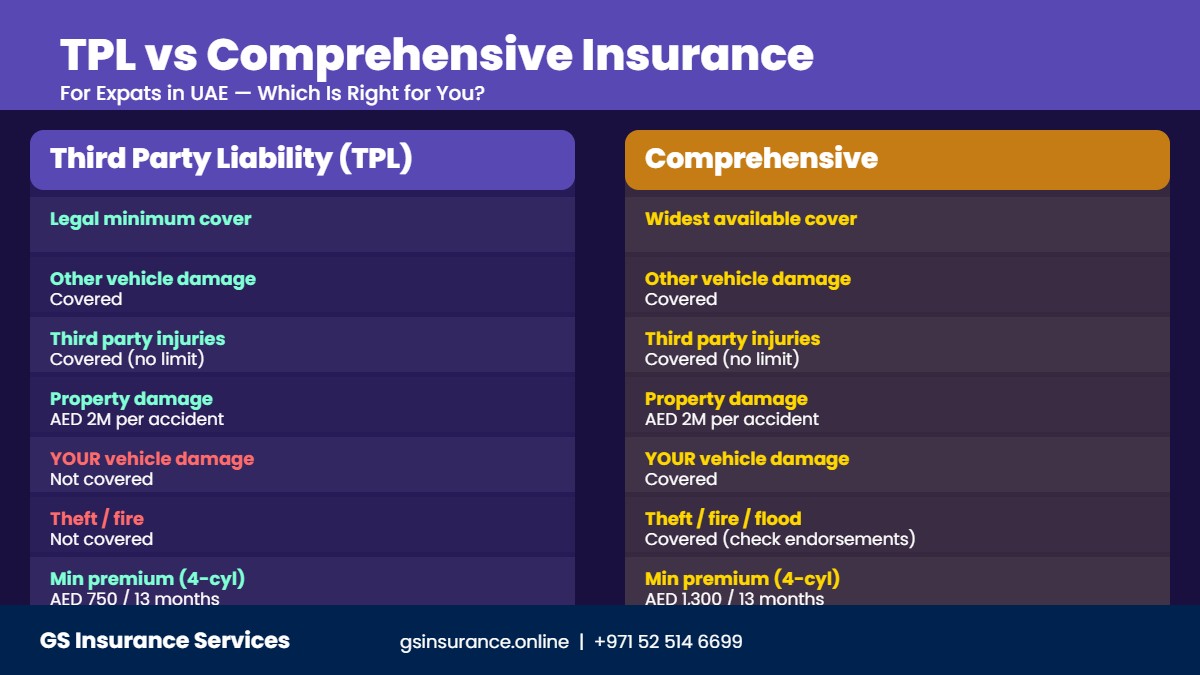
Car insurance for expats in UAE is available in two main forms. Third party liability (TPL) is the legal minimum — it covers damage and injury you cause to other people and their property, but nothing for your own vehicle. Comprehensive (loss and damage plus TPL) adds cover for your own vehicle against accidents, fire, theft, flood and other perils.
The CBUAE tariff sets minimum and maximum premiums for both. For a four-cylinder private saloon, the TPL minimum is AED 750 per 13 months and the maximum is AED 1,300. Comprehensive cover for the same saloon has a minimum premium of AED 1,300 with a maximum rate of 5% of the vehicle’s value.
For most expats, especially those with newer or financed vehicles, comprehensive insurance is the right choice. If your car is financed through a UAE bank, the bank will almost certainly require comprehensive cover as a loan condition. For older vehicles worth under AED 30,000, TPL may be sufficient — but weigh the cost of replacing the vehicle out of pocket if it is written off.
Agency Repair: What Expat Car Owners Should Know
One of the most valuable features of car insurance for expats in UAE — and one that most newcomers are unaware of — is agency repair. Under CBUAE rules, a comprehensive policy must include repair at the manufacturer’s authorised service centre using original parts, with no depreciation deduction, for the first policy year.
This is particularly important if your car is still under the manufacturer’s warranty. Repairs at non-agency workshops can void the warranty — agency repair cover in your insurance policy prevents this. After the first year, the insurer may direct repairs to suitable workshops using equivalent-grade parts. If you want agency repair to continue beyond year one, negotiate it explicitly into your renewal — some insurers offer it as a paid add-on.
No-Claims Discount for Expats: Can You Transfer Your Record?
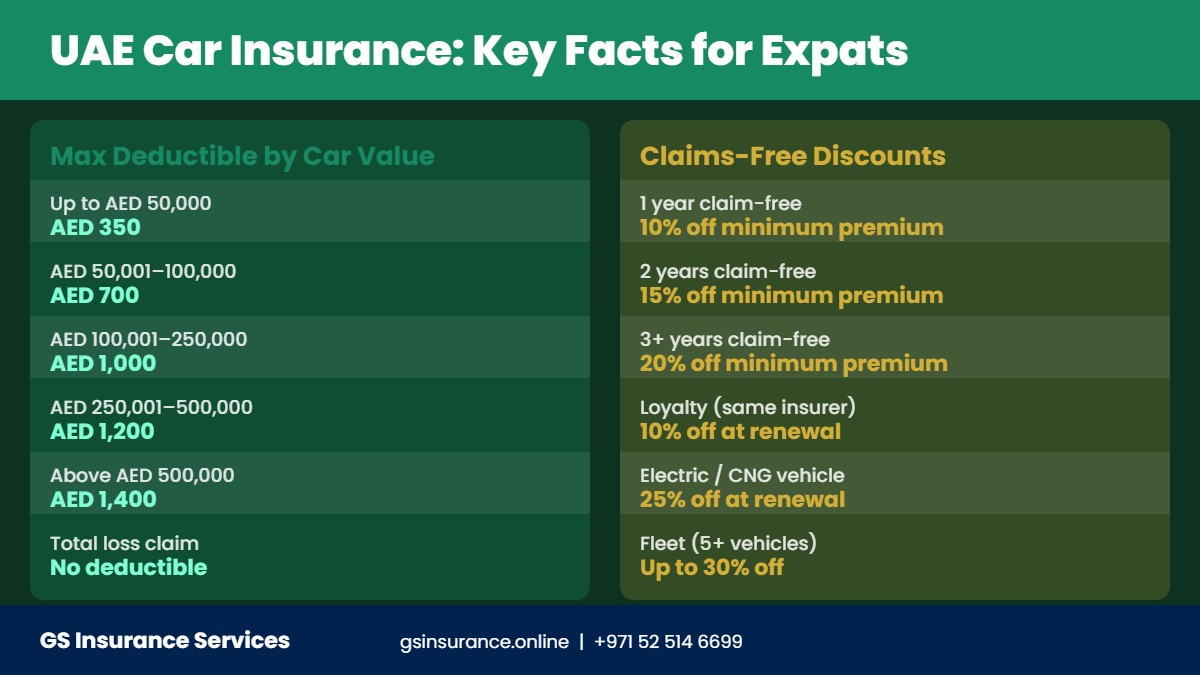
The CBUAE tariff provides claims-free discounts of 10% (one year), 15% (two years) and 20% (three or more years) on the minimum premium. These apply to your record in the UAE — not your record from your home country.
Some insurers informally accept a claims-experience certificate from a reputable insurer in your home country as evidence of a claim-free history, particularly from GCC countries, the UK, the USA, Canada and Australia. This is not a CBUAE requirement — it is at the individual insurer’s discretion. Ask specifically when comparing quotes for car insurance for expats in UAE, and get any discount agreement in writing on the policy schedule.
Deductibles Expats Need to Understand
Every comprehensive policy includes a basic deductible — the amount you pay first before the insurer covers the rest. The CBUAE sets maximum deductible amounts based on vehicle value. For a private vehicle worth up to AED 50,000, the maximum deductible is AED 350 per accident. For a vehicle worth AED 100,001 to AED 250,000, the maximum is AED 1,000.
There is also a percentage deductible for under-25 drivers of up to 10% of the claim — relevant for young expat professionals or students. Only the highest single deductible applies; they do not stack. In a total loss, no deductible applies at all.
Total loss is declared when repair costs exceed 50% of the vehicle’s market value, or when the chassis or pillars require cutting or welding. In this case, the insurer pays out the insured value minus depreciation rather than repairing the vehicle.
Flood and Natural Disaster Cover for Expats
The UAE experienced significant flash flooding in April 2024, and many expat car owners discovered that their standard comprehensive policies did not automatically include flood cover. Under the CBUAE policy terms, natural disaster cover — including floods — requires a specific endorsement in the Loss and Damage schedule.
When buying car insurance for expats in UAE, ask explicitly: “Does this policy cover flood and natural disasters?” A policy without this endorsement will not pay for flood damage, even if marketed as “comprehensive”. GS Insurance Services confirms the specific perils covered on every policy before issuance.
Third Party Liability Limits Every Expat Should Know
If you cause an accident that injures or kills another person, your TPL cover pays without a monetary limit — the court determines the amount and the insurer pays it. For third-party property damage, the CBUAE cap is AED 2,000,000 per accident. For the death of your own spouse, parent or child in an accident, the fixed payout is AED 200,000 per person.
These limits apply to all drivers in the UAE equally — there is no separate expat scale. Understanding them helps you assess whether the minimum TPL cover is sufficient for your situation or whether additional personal accident cover is worth adding.
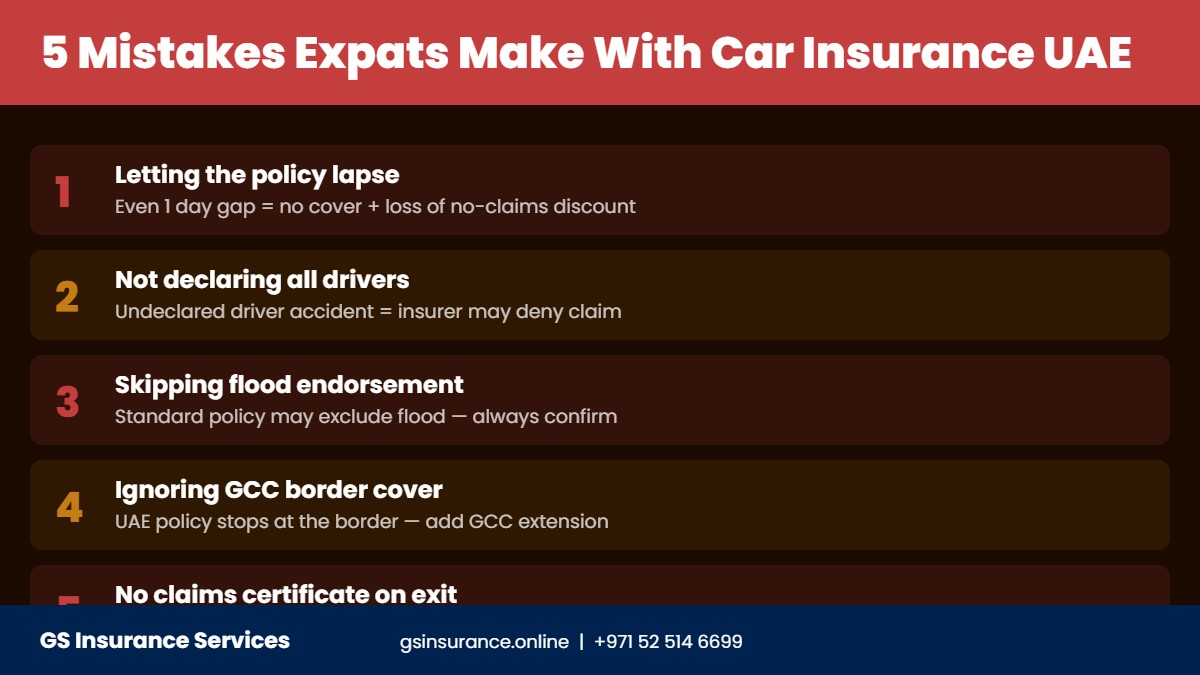
Common Mistakes Expats Make With UAE Car Insurance
Assuming the policy works like home: UAE car insurance follows CBUAE rules, not the rules of your home country. Read the schedule carefully — what is standard in Germany or India may be an optional add-on here, or absent entirely.
Not declaring all drivers: if you regularly let your spouse or a family member drive your car, they must be declared on the policy. An undeclared driver causing an accident gives the insurer grounds to limit or deny the claim.
Letting the policy lapse: even one day without valid insurance means no cover for any incident during that gap. Set a reminder one month before your 13-month policy expires. Some expats returning home temporarily assume their UAE policy stays valid — it does not pause; it continues and expires on the scheduled date.
Not getting a claims-experience certificate when leaving: if you plan to return to the UAE, your claim-free record is valuable. Before cancelling your policy, request a claims-experience certificate from your insurer — it is free under CBUAE rules and must be provided on request. You may be able to use it when you return.
Frequently Asked Questions: Car Insurance for Expats in UAE
Can I buy car insurance in UAE without a UAE driving licence?
Most UAE insurers require a UAE driving licence to issue a policy. Some accept an international driving permit alongside a valid home-country licence for recently arrived expats. Convert your licence to a UAE licence as soon as possible — driving on a home-country licence beyond the allowed grace period is a traffic offence.
Is car insurance cheaper for expats or UAE nationals?
The CBUAE tariff sets the same minimum and maximum premiums for all drivers regardless of nationality. However, the rate within that range reflects your individual risk profile — age, claims history, vehicle type — not your nationality. A claim-free expat and a claim-free national pay the same minimum premium.
Can I use my home country no-claims discount in UAE?
Not automatically. The CBUAE discount system is based on your UAE claims record. Some insurers accept overseas claims-experience certificates from certain countries as a courtesy, but this is discretionary. Ask specifically when getting quotes.
What happens if I am in an accident and my visa has expired?
An expired visa does not automatically void your insurance policy — the policy is between you and the insurer for the stated period. However, driving on an expired visa is a separate legal issue. Report the accident through the normal police and insurance channels and consult a legal adviser about your visa status separately.
Does my UAE car insurance cover me driving in other GCC countries?
Standard UAE motor policies cover driving within the UAE only. For GCC cross-border travel, you need a GCC extension (also called a green card or Gulf extension). This can be added to most comprehensive policies for a small additional premium. Always check before driving across any UAE border.
How do I cancel my UAE car insurance if I am leaving the country?
You can cancel your policy and claim a short-rate refund based on the CBUAE table: 80% refund if cancelled within the first month, reducing to nil after ten months for a comprehensive policy. Request your claims-experience certificate at the same time — it is free and takes a few days to issue.
Get Car Insurance for Expats in UAE Through GS Insurance Services
GS Insurance Services has arranged car insurance for expats across the UAE for over eight years. We compare quotes from multiple licensed UAE insurers, confirm the exact perils covered — including flood — and handle the documentation on your behalf at no extra charge.
WhatsApp our team at +971 52 514 6699 or email admin@gsinsurance.ae. We are based in Ajman and serve expats across all seven emirates — whether you are newly arrived or renewing for the fifth time.
GS Insurance Services works as a sales intermediary. Every policy is issued and underwritten by a licensed UAE insurance company regulated by the Central Bank of UAE.
Official rules: CBUAE Motor Insurance Rulebook
