

Property all risk insurance is what pays to rebuild your warehouse, shop, office or villa after a fire, a burst pipe or a storm. However, the name misleads people. “All risk” does not mean everything. Instead, it means the policy covers any sudden, accidental physical damage unless the wording names it as an exclusion. Therefore the exclusion list is the part that matters, and it is the part almost nobody reads.
This guide sets out what the cover does, what it refuses, and how the UAE actually regulates the companies selling it. Also, it shows you how to check an insurer is genuine before you pay, and exactly where to complain if a claim gets refused.
What property all risk insurance actually covers
The policy pays for sudden, accidental, physical damage to the building and to what sits inside it. So a typical UAE wording responds to:
- Fire, lightning, explosion and smoke damage
- Burst pipes, water tank leaks and escape of water from air-conditioning
- Storm, rain and flood damage to the structure
- Impact by vehicles, falling objects and aircraft
- Theft and burglary involving forcible entry
- Malicious damage and riot, where the wording includes it
- Accidental breakage of fixed glass and sanitary ware
Cover normally splits into three parts. First, the building: walls, roof, floors and permanent fixtures. Second, the contents: stock, machinery, furniture and fit-out. Third, business interruption, which replaces the income you lose while the place is unusable.
The UAE Government lists property insurance as one of the four main classes available in the country, alongside life, health and liability cover.
Who needs property all risk insurance in the UAE
No federal law forces a private owner to insure a building. However, three situations make it effectively compulsory.
- A mortgage. Banks will not release the loan without building cover in place. So the lender, not the law, is what obliges you.
- A commercial lease. Most UAE landlords write an insurance clause into the tenancy contract for shops, offices and warehouses.
- A trade licence condition or a client contract. Contractors and logistics firms are routinely asked to evidence cover before a contract starts.
Meanwhile landlords and tenants insure different things. Generally the landlord covers the structure, while the tenant covers stock, fit-out and equipment. So check the tenancy contract before you assume you are protected.
How to choose the best property all risk insurance in the UAE
“Best” rarely means cheapest. Instead, it means the policy that actually pays when your building burns, floods or collapses. Therefore judge every quote against the same eight checks, in this order.
- Is the insurer licensed? Check the name against the CBUAE register before anything else. An unlicensed policy is worth nothing, however cheap it looks.
- Is the sum insured a rebuild figure? If the quote was built on market value, the average clause will cut your payout later.
- How long is the exclusion list? Two policies at the same price can differ enormously here. Read this before the premium.
- What is the deductible per event? A low premium with a huge excess simply moves the cost to claim day.
- Does it include escape of water and storm? In the UAE these cause more claims than fire does.
- Is business interruption included, and for how many months? An indemnity period shorter than your realistic rebuild time will leave a gap.
- Are subsidence, flood and terrorism inside or outside? Some wordings carve these out entirely, others price them as extensions.
- Who handles the claim? Ask which licensed surveyor and loss adjuster the insurer appoints, and how fast.
Above all, compare wordings side by side rather than premiums side by side. Consequently you will notice that the cheapest quote is often the narrowest one.
Property all risk insurance compared with the alternatives
People often buy the wrong product because the names overlap. So here is how the three main options differ in practice.
| Cover | What it protects | Typical buyer | Trigger |
|---|---|---|---|
| Property all risk | Building, contents, plant and stock | Business owners, landlords, industrial units | Any sudden accidental damage unless excluded |
| Fire and allied perils | Building and contents | Budget-conscious owners, lender minimum | Only the perils named in the policy |
| Home / contents | Personal belongings, sometimes the structure | Villa and apartment residents | Named perils, usually with personal liability |
Notice the difference in the last column, because that single distinction decides most disputes. Fire and allied perils pays only if your loss appears on its list. Meanwhile property all risk insurance pays unless your loss appears on its exclusion list. As a result, the burden effectively shifts to the insurer, which is why the wider cover generally costs more.
The UAE Government classifies property insurance as motor, fire and marine. Property all risk therefore sits inside the fire branch, even though it reaches far beyond fire.
What property all risk insurance does not cover
Every UAE wording carries an exclusion list. In short, these are the usual ones:
- Wear and tear, gradual deterioration, rust and corrosion
- Faulty workmanship, design defects and poor maintenance
- Damage that builds up slowly, such as a long-running leak
- Termites, vermin, mould and damp
- War, terrorism, nuclear risk and government confiscation
- Electronic data loss and cyber events, unless bought separately
- Property left unoccupied beyond the number of days the policy allows
That last one catches people out. Leave a villa or a warehouse empty past the stated limit, and the cover can lapse quietly. Therefore tell your insurer before a long vacancy.

Getting the sum insured right
This is where most UAE claims lose money. Insure the building for what it costs to rebuild, not for what it would sell for. Land value is not at risk in a fire, so market price is the wrong number.
If you understate the sum insured, the average clause applies. So the insurer reduces the payout by the same proportion you underinsured. Insure for half of what rebuilding costs, and you can recover roughly half of the loss even on a small claim. Meanwhile overinsuring simply wastes premium, because the policy pays the loss, not the sum insured.
Review the figure every year. Construction and fit-out costs move, and a number set three years ago is usually too low today.
Property all risk insurance and your UAE mortgage
If the property carries a mortgage, the lender takes an interest in your policy. However, the position is often described loosely online, so it is worth being precise.
The CBUAE Regulations Regarding Mortgage Loans (Circular 31/2013, in force) do not themselves oblige you to buy property insurance. Instead, Article (4) requires the lender to set out the insurance requirement in the loan documentation, alongside the loan amount, repayment period, instalment and profit rate. Therefore the obligation reaches you through the loan contract rather than through the regulation.
In practice, UAE lenders do require buildings cover for the reinstatement value and ask to be named on the policy. Consequently you should read the insurance clause in your facility agreement and match your sum insured to it. Otherwise a shortfall becomes your problem, not the bank’s.
How much you can actually borrow
The same regulation caps how much you can borrow, which indirectly shapes the value you need to insure.
| Borrower and property | Maximum loan to value |
|---|---|
| UAE national, first home, value up to AED 5 million | 85% |
| UAE national, first home, value above AED 5 million | 75% |
| UAE national, second or investment property | 65% |
| Expatriate, first home, value under AED 5 million | 80% |
| Expatriate, first home, value above AED 5 million | 70% |
| Expatriate, second or investment property | 60% |
| Any borrower, property bought off plan | 50% |
Additionally, the maximum mortgage term is 25 years, and the debt burden ratio may not exceed 50% of gross salary and regular income. Lenders must also stress test the loan at two to four percentage points above the current rate.
One more detail matters for the sum insured. Before any irrevocable commitment to lend, the regulation requires an independent on-site valuation by a qualified third party. That valuation is a lending figure, though. It is not the same as your rebuilding cost, so never copy it straight onto your insurance schedule.
Business interruption: the part people skip
Rebuilding takes months. During that time the rent still runs, salaries still run, and revenue stops. Business interruption cover replaces that lost gross profit and pays the continuing costs.
Two numbers decide whether it works. First, the indemnity period: the months the insurer will keep paying. Twelve months rarely suits a warehouse or a factory, because permits and rebuilding take longer. Second, the sum insured, which should be gross profit over that whole period, not annual profit.
How to check the insurer is genuine
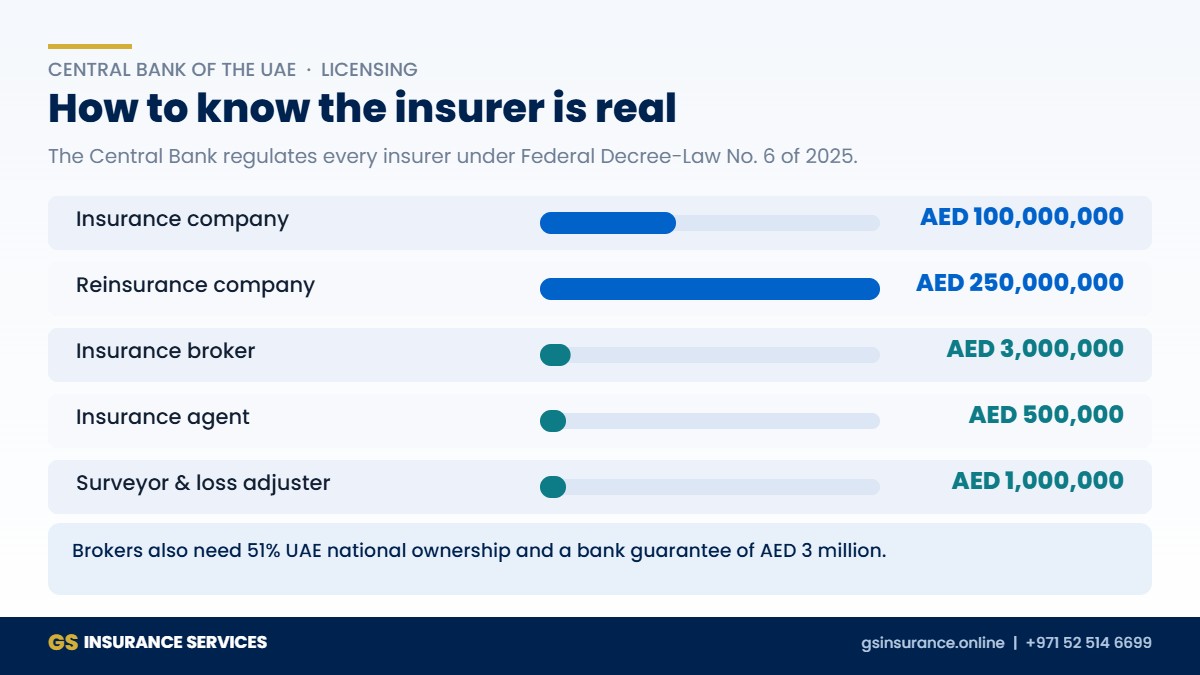
Here is the part no comparison site tells you. The Central Bank of the UAE supervises and regulates the entire insurance sector under Federal Decree-Law No. 6 of 2025. So every legitimate insurer is licensed and listed by the CBUAE.
The capital thresholds are high, and that is deliberate:
| Entity | Minimum capital required |
|---|---|
| Insurance company operating in the UAE | AED 100,000,000 |
| Reinsurance company | AED 250,000,000 |
| Insurance broker | AED 3,000,000 paid-up, plus bank guarantee |
| Insurance agent | AED 500,000 paid-up |
| Surveyor and loss adjuster | AED 1,000,000 |
Brokers also need at least 51% UAE national ownership and a bank guarantee of AED 3 million for the head office, plus AED 1 million for each branch. So before you pay anyone, ask which licensed insurer will actually issue the policy, then check that company against the CBUAE register.
Who decides what your damage is worth
When you and the insurer disagree on the value of the damage, the assessment does not stay in the insurer’s hands. A registered Surveyor and Loss Adjuster detects and assesses the loss. These firms are separately licensed, need AED 1 million of capital, and must carry their own AED 1 million civil liability policy against mistakes in their work.
So if the figure you are offered looks wrong, ask who the appointed surveyor is and whether they are registered. That single question changes many conversations.
What to do if your property all risk insurance claim is refused
You are not stuck with the insurer’s answer. The UAE runs an official complaints channel called Sanadak, and it handles insurance disputes.
- First, put the complaint to the insurer in writing and keep the reference.
- Then give them a reasonable period to answer.
- Finally, if the answer does not satisfy you, file the complaint through Sanadak.
Keep everything: photographs dated at the time, the police or civil defence report, purchase invoices, the surveyor’s report and every email. Claims usually fail on evidence, not on principle.

The comparison-website rule most people do not know
Price comparison websites operate under a specific restriction in the UAE. They are prohibited from communicating directly with the customer. Any contact must run through a licensed insurance broker contracted with that website. Furthermore, insurance companies and insurance professionals other than brokers may not deal with comparison websites at all.
So if a comparison site calls you directly about a property quote, that is a signal worth pausing on.
Property all risk insurance and the new Civil Transactions Law
One change matters for anyone insuring a newer building. The UAE replaced its Civil Transactions Law. Federal Decree-Law No. 25 of 2025 was issued on 1 October 2025, published in Official Gazette 809, and came into force on 1 June 2026. It replaces the 1985 Civil Code that most online articles still quote.
UAE law has long held contractors and designers strictly liable for a period of years after handover, for collapse and for defects that threaten a building’s stability. That liability sits alongside your property policy rather than replacing it. However, because the governing law has just changed, confirm the current article and time limits with a UAE lawyer before you rely on them in a dispute.
Property all risk insurance in Dubai and the other emirates
Insurance regulation in the UAE is federal. Therefore the licensing rules, the complaints route and the professional standards are identical in Dubai, Abu Dhabi, Sharjah, Ajman, Ras Al Khaimah, Fujairah and Umm Al Quwain.
Nevertheless, the risk itself is not identical, and underwriters price accordingly. Consider what actually changes between emirates:
- Building type and age. A 2008 Dubai tower and a 2024 Ajman warehouse present very different fire loads and very different rebuild costs.
- Flood and storm exposure. Low-lying and coastal areas draw more rain and escape-of-water claims, so wordings and deductibles tighten there.
- Occupancy. A restaurant, a paint store and an office in the same building are not the same risk, whatever the emirate.
- Rebuild cost per square metre. Construction and fit-out costs differ across emirates, which changes the correct sum insured for an identical-looking unit.
- Civil defence and fire safety compliance. Insurers increasingly ask for evidence of it, and it can move both price and terms.
So a quote written for a Dubai property does not automatically suit a Sharjah or Ajman one. Instead, the schedule should reflect the actual location, occupancy and rebuild cost of that specific unit.
Wherever the property sits, the same two verification steps apply. First, confirm the issuing insurer holds a CBUAE licence. Second, if a claim is refused, take it to Sanadak, the official complaints channel, which covers the whole country.
How to buy property all risk insurance
Keep the process short. First, calculate the rebuilding cost and the contents value. Second, decide whether you need business interruption and for how many months. Third, read the exclusion list before the price. Finally, confirm which licensed insurer issues the policy.
GS Insurance Services arranges property all risk cover across all seven emirates for villas, offices, shops, warehouses and industrial units. We compare wordings from licensed UAE insurers, so you see the exclusions and not only the premium.
Send your property details on WhatsApp: +971 52 514 6699 and we will come back with options. Alternatively, use our contact page. You may also want our guides to contractors plant and machinery insurance, cargo insurance, workmen compensation and business insurance types in the UAE.
Frequently asked questions
How much does property all risk insurance cost?
Insurers price it as a rate on the total sum insured, so the building value, construction type, occupancy and claims history all move the number. Therefore a concrete office block costs far less to insure than a warehouse storing flammable stock.
Is property insurance mandatory in the UAE?
No federal law compels a private owner to buy it. However, mortgage lenders and most commercial landlords require it, so in practice many owners have no choice.
What is the difference between property all risk and fire insurance?
Fire insurance lists the perils it will pay for. Property all risk works the other way round: it pays for accidental damage unless the wording excludes it. So all risk is wider, and the exclusion list defines the limit.
Does it cover flood and rain damage?
Standard UAE wordings usually include storm and flood damage to the structure. Still, check for a separate deductible on water damage, because insurers often apply a higher one.
Do landlords and tenants both need cover?
Yes, for different things. The landlord insures the structure. Meanwhile the tenant insures stock, fit-out, equipment and business interruption.
Who assesses the damage after a claim?
A registered Surveyor and Loss Adjuster. They hold their own licence, AED 1 million of capital and AED 1 million of professional liability cover.
Where do I complain if my claim is refused?
Complain to the insurer in writing first. Then, if you are not satisfied, file it through Sanadak, the official UAE complaints channel for insurance.
What makes one property all risk insurance policy better than another?
Mainly the exclusion list, the deductible and the indemnity period, rather than the premium. Two quotes at the same price can differ sharply on escape of water, flood, subsidence and business interruption. Therefore compare wordings side by side, not prices side by side.
How do I check an insurer is licensed in the UAE?
The Central Bank publishes a register of licensed insurance companies and related businesses. Check the exact legal name on the quote against that register before you pay. Furthermore, remember that a price comparison website may not contact you directly; only a licensed broker contracted with the site may do that.
Does a UAE mortgage force me to buy property insurance?
Not through the regulation itself. Article (4) of the CBUAE mortgage regulations requires the lender to state the insurance requirement in your loan documentation, so the obligation reaches you through the loan contract. In practice lenders do require buildings cover and ask to be named on the policy.
Sources
- The Official Portal of the UAE Government – Insurance
- CBUAE Rulebook
- Federal Decree-Law No. 25 of 2025 Promulgating the Civil Transactions Law
GS Insurance Services works as a sales intermediary. A licensed UAE insurance company issues and underwrites every policy. This article gives general information based on published official sources, and it is not legal advice or advice on a specific policy. Always read your own policy schedule and confirm the terms with your insurer.
